
If you live in San Diego, knowing SDG&E peak hours can make a noticeable difference in your electricity bill. Under SDG&E’s current residential Time-of-Use (TOU) schedules, 4 p.m. to 9 p.m. is the key on-peak period, while lower-cost periods are available outside those hours. Some plans also provide a super off-peak window from midnight to 6 a.m. and 10 a.m. to 2 p.m. on weekdays.
The exact price depends on your rate plan, whether you have solar or an EV, and whether your electricity generation comes from SDG&E or a Community Choice Aggregation provider.
What Are SDG&E Peak Hours in 2026?
For many residential SDG&E TOU plans, peak or on-peak hours are 4 p.m. to 9 p.m. every day. Electricity generally costs more during this window because demand is higher. SDG&E recommends shifting flexible electricity use outside the on-peak period when possible.
A common 2026 schedule for plans such as EV-TOU-5 is:
| Time | Weekdays | Weekends & Holidays |
|---|---|---|
| 12 a.m.–6 a.m. | Super off-peak | Super off-peak |
| 6–10 a.m. | Off-peak | Super off-peak until 2 p.m. |
| 10 a.m.–2 p.m. | Super off-peak | Super off-peak |
| 2–4 p.m. | Off-peak | Off-peak |
| 4–9 p.m. | On-peak | On-peak |
| 9 p.m.–midnight | Off-peak | Off-peak |
SDG&E’s current pricing information shows this schedule for residential plans with three pricing periods, including EV-TOU-5.
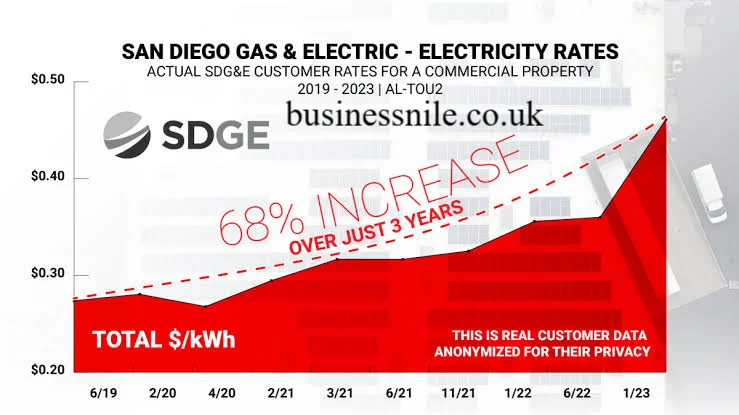
Why Are 4–9 p.m. Hours More Expensive?
The 4–9 p.m. period typically has greater electricity demand. SDG&E’s explanation of TOU pricing is straightforward: customers can reduce costs by moving electricity use away from higher-cost on-peak hours.
That means activities such as laundry, EV charging, dishwashing, pool pumping and other flexible loads can often be scheduled before 4 p.m. or after 9 p.m.
What Are SDG&E Super Off-Peak Hours?
On residential plans that include a super off-peak period, the current schedule is midnight to 6 a.m. and 10 a.m. to 2 p.m. on weekdays. On weekends and listed holidays, super off-peak runs from midnight to 2 p.m.
This expanded daytime window is particularly important for households with:
- Electric vehicles
- Rooftop solar
- Home battery storage
- Electric heat pumps
- Flexible appliances
- High daytime electricity consumption
The midday period can also align well with solar production, allowing homeowners to consume more electricity while their panels are generating power.
SDG&E Peak, Off-Peak and Super Off-Peak Schedule
The most important distinction is simple:
- On-peak: 4 p.m.–9 p.m.
- Super off-peak: midnight–6 a.m. and 10 a.m.–2 p.m. on applicable weekdays
- Off-peak: most remaining hours
- Weekend/holiday super off-peak: midnight–2 p.m. on applicable three-period plans
However, not every SDG&E pricing plan uses the same number of pricing periods. For example, TOU-DR2 has only on-peak and off-peak periods and lists 4 p.m.–9 p.m. as on-peak every day.
Therefore, always check the schedule attached to your specific rate plan rather than assuming every SDG&E customer has identical rates.
SDG&E Peak Hours Today
If today is a regular day and you are on a residential plan using the standard 4–9 p.m. on-peak window, the most expensive period is generally:
4 p.m. to 9 p.m.
For September 9, 2026, that means customers on applicable TOU plans should generally avoid unnecessary electricity use during this five-hour window.
SDG&E also operates event-based programs where customers may be asked to reduce electricity use during specific periods. Its current activation information identifies 4–9 p.m. as the conservation period for residential Reduce Your Use/Time-of-Use Plus customers.
Are SDG&E Peak Hours Different on Saturday and Sunday?
The answer depends on your pricing plan. On three-period residential plans such as EV-TOU-5, the current schedule keeps 4–9 p.m. as on-peak on weekends and holidays, while midnight–2 p.m. is super off-peak.
So Saturday and Sunday do not automatically mean electricity is cheap all day.
For example, if you are charging an EV, running a pool pump or using a high-powered appliance, shifting that activity to the weekend morning can be more advantageous than running it between 4 and 9 p.m.
How SDG&E Time-of-Use Rates Work
SDG&E time-of-use rates charge different prices depending on when electricity is consumed.
The concept is simple:
- Use less electricity during on-peak hours.
- Move flexible loads to off-peak periods.
- Take advantage of super off-peak periods when your plan provides them.
- Compare your actual usage against available pricing plans.
SDG&E currently describes TOU plans as a way to control energy costs by changing when electricity is used rather than simply reducing total consumption.
Current 2026 Rate Examples
SDG&E’s pricing-plan information lists different prices depending on the plan and customer situation. For example, its current non-CCA EV-TOU-5 pricing displays approximately 13.1¢/kWh super off-peak, 49.6¢ off-peak and 80.2¢ on-peak under the displayed August 1, 2026 pricing. These figures are rounded and plan-specific.
The important point is not to apply one rate to every household. Your actual electricity cost can vary according to the rate plan, generation provider, baseline allocation and other charges.
Which SDG&E Rate Plan Is Best in 2026?
There is no single best SDG&E rate plan for everyone. The right choice depends on your household’s equipment and electricity habits.
EV-TOU-5
EV-TOU-5 can be particularly attractive for EV owners and Solar Billing Plan customers who can shift usage away from 4–9 p.m.
SDG&E specifically describes EV-TOU-5 as a plan designed for customers who charge EVs at home and/or customers on the Solar Billing Plan. It also highlights battery storage as another way solar customers can reduce on-peak electricity use.
TOU-ELEC
TOU-ELEC is designed for qualifying households with technologies such as EVs, energy storage or electric heat pumps.
SDG&E’s 2026 tariff identifies customers with qualifying EVs, Rule 21-connected behind-the-meter energy storage or qualifying electric heat pumps as eligible for this schedule.
TOU-DR1
TOU-DR1 is a standard residential three-period TOU option. It can make sense for households that can move electricity use away from the 4–9 p.m. period and take advantage of lower-cost periods.
TOU-DR2
TOU-DR2 uses two pricing periods rather than a three-period structure. SDG&E currently lists 4–9 p.m. as on-peak and the remaining listed hours as off-peak.
DR-SES
DR-SES is associated with legacy solar customers and should be evaluated according to the customer’s existing solar arrangement and eligibility. Solar customers should not switch plans based solely on a headline rate difference because export compensation and other billing rules also matter.
Standard DR
Standard DR is a non-TOU structure and can be worth comparing if your household cannot easily shift electricity use away from peak periods.
How Do SDG&E Peak Hours Affect Solar Customers?
Solar changes the calculation because you may produce electricity during the same hours when electricity prices are changing.
For NEM 2.0, the CPUC explains that eligible exports can be credited using applicable import rates, subject to the rules of the tariff. For Solar Billing Plan/NEM 3.0, export credits are based on CPUC Avoided Cost Calculator values rather than simply receiving the retail import rate.
That distinction is important.
NEM 2.0
NEM 2.0 customers generally benefit from retail-rate export treatment under their applicable tariff, although non-bypassable charges and TOU timing affect the economics.
NEM 3.0 / Solar Billing Plan
NEM 3.0 customers receive export compensation based on avoided-cost values, which can make self-consumption and battery storage especially important.
Rather than exporting every kilowatt-hour produced at midday, a solar-plus-battery household can potentially store electricity and use it later during the 4–9 p.m. on-peak period.
Why Battery Storage Matters
Battery storage can turn SDG&E’s rate structure into an energy-shifting opportunity.
A typical strategy is:
- Generate solar electricity during the day.
- Use some electricity immediately.
- Store excess electricity in the battery.
- Avoid expensive 4–9 p.m. electricity.
- Recharge during a lower-cost period when appropriate.
This is commonly called battery arbitrage.
The actual savings depend on the battery’s usable capacity, round-trip efficiency, rate plan, solar production, household demand and battery-control settings. Therefore, a simple battery capacity multiplied by the rate difference should not be treated as guaranteed profit.

How Much Can You Save?
The savings from changing electricity usage can be calculated simply:
Savings = shifted kWh × difference between the applicable rates
For example, if a household moves 100 kWh of electricity from a higher-priced period to a period that costs 20 cents less per kWh:
100 × $0.20 = $20 in potential monthly savings
The actual bill impact can be different because of fixed charges, baseline allowances, generation charges, delivery charges, taxes and other components.
Best Things to Shift
Consider scheduling these activities outside 4–9 p.m.:
- EV charging
- Laundry
- Dishwasher
- Pool pump operation
- Electric water heating
- HVAC pre-cooling
- Battery charging
- Other flexible high-energy appliances
How to Save With SDG&E Peak Hours
If You Don’t Have Solar
Move as much flexible electricity consumption as practical away from 4–9 p.m.
The easiest starting point is usually EV charging, laundry, dishwashing and pool equipment.
If You Have Solar Without a Battery
Use more of your solar electricity directly during daylight hours instead of relying on exports when possible. Running flexible appliances while your panels are producing can increase self-consumption.
If You Have Solar and a Battery
Configure the system around your actual TOU plan. The goal may be to use solar during the day, store excess energy and reduce grid purchases during the 4–9 p.m. on-peak period.
Do not assume a battery will automatically pay for itself. Compare its installed cost, usable capacity, degradation, financing and expected bill savings.
San Diego Community Power Customers
San Diego Community Power customers need to distinguish between generation and delivery charges.
SDG&E can continue providing delivery service while a Community Choice Aggregation provider supplies generation. SDG&E’s current pricing pages note that CCA customers may see SDG&E delivery charges while generation prices are determined by the CCA.
The TOU schedule remains important because the timing of electricity consumption still affects applicable charges.
What Should You Do Now?
If you want to lower your San Diego electricity bill, start with your actual usage rather than choosing a rate plan based on a single advertised price.
- Check your current SDG&E rate plan.
- Identify how much electricity you use between 4 and 9 p.m.
- Move flexible loads outside peak hours.
- Compare available SDG&E rate plans.
- If you have solar, review your export and self-consumption patterns.
- If you own an EV, compare EV-specific plans.
- If you have a battery, calculate its actual TOU savings.
- Review your generation provider if you are a Community Power customer.
SDG&E provides a pricing-plan comparison tool so customers can compare plans using their own usage information.

SDG&E Peak Hours FAQs
What are SDG&E peak hours today?
For many current residential TOU plans, SDG&E peak hours are 4 p.m. to 9 p.m. However, your exact schedule depends on the pricing plan.
What are SDG&E peak hours Saturday?
On current three-period residential plans such as EV-TOU-5, Saturday peak hours are 4 p.m. to 9 p.m. The midnight-to-2-p.m. period is super off-peak.
What are SDG&E super off-peak hours on weekends?
For applicable three-period residential plans, super off-peak hours on weekends and holidays are midnight to 2 p.m.
What are SDG&E peak hours Sunday?
For applicable residential three-period TOU plans, Sunday on-peak hours are generally 4 p.m. to 9 p.m.
What are SDG&E off-peak hours?
On plans such as EV-TOU-5, off-peak hours generally include 6–10 a.m., 2–4 p.m. and 9 p.m.–midnight on weekdays, while the exact schedule can differ by plan.
What are SDG&E peak hours in 2026?
The primary residential on-peak period for many SDG&E TOU plans in 2026 is 4–9 p.m.
What are SDG&E super off-peak hours in 2026?
For current three-period residential plans, super off-peak is midnight–6 a.m. and 10 a.m.–2 p.m. on weekdays, plus midnight–2 p.m. on weekends and listed holidays.
What are SDG&E off-peak rates?
There is no single SDG&E off-peak rate for every customer. The price depends on the rate plan, generation provider, customer type and current tariff. SDG&E’s pricing-plan pages show plan-specific rates and effective dates.
Final Takeaway
For most households searching for SDG&E peak hours, the most important number to remember is 4 p.m. to 9 p.m. That’s the key on-peak window on many current residential TOU plans.
The biggest savings opportunity is usually to shift flexible electricity use outside those hours. Households with EVs, solar panels or batteries have additional opportunities because they can schedule charging, self-consumption and storage around SDG&E’s off-peak and super off-peak periods.
Because SDG&E offers multiple rate plans and prices can change, use your actual usage and current tariff when deciding which plan is best.
About the Author: Hamid is a finance and energy writer covering electricity rates, utility costs, solar energy, and household savings. He creates clear, practical guides to help readers understand energy pricing and make smarter financial decisions.
Author Name: Hamid Ali
Email: johanharwen314@gmail.com
Also Read: