Introduction About: How to Start an Online Business
Starting an online business can be one of the most accessible ways to turn a skill, product, or idea into a source of income. You do not necessarily need a storefront, a large team, or a huge amount of capital. However, a low barrier to entry does not mean an online business is effortless.
The smartest approach is to solve a specific customer problem, validate demand, choose an appropriate business model, establish the business properly, and build a reliable way to attract and serve customers.
For U.S. entrepreneurs, the opportunity remains significant. According to the U.S. Census Bureau’s August 2026 release, retail e-commerce sales reached an estimated $340.2 billion in Q2 2026, up 12.2% from Q2 2025 and representing 17.1% of total retail sales.
So, how do you actually get started?
What Is an Online Business?
An online business is a business that uses the internet as a primary channel to sell products, provide services, attract customers, or generate revenue.
Examples include:
- Ecommerce stores
- Dropshipping businesses
- Freelance services
- Consulting
- Affiliate marketing
- Online courses
- Digital products
- Membership websites
- Blogging and content businesses
- Software and online tools
Some businesses operate entirely online, while others combine an online presence with physical operations.
The important point is that an online business still needs the fundamentals of any other business: a customer, a valuable offer, a business model, operating processes, and a way to generate sustainable revenue.
How to Choose the Right Online Business Idea
The best online business idea is not necessarily the newest or most popular one. It should match customer demand, your capabilities, available resources, and your ability to deliver value consistently.
Start by asking:
- What problem can I solve?
- Who has this problem?
- Are people already paying for a solution?
- What can I offer that is better, simpler, faster, cheaper, or more convenient?
- Can I reach potential customers online?
- How much money can I realistically invest?
For example, someone with strong writing skills might start a freelance writing business, while someone with product knowledge could build an ecommerce business.
A Simple Way to Validate an Idea
Before spending heavily, test your idea.
Look at:
- Search demand
- Customer reviews
- Competitor websites
- Social media discussions
- Online marketplaces
- Existing products and services
- Pricing in the market
The goal is not to prove that everyone wants your idea. Instead, you want enough evidence that a specific group of customers has a real problem and is willing to pay for a solution.
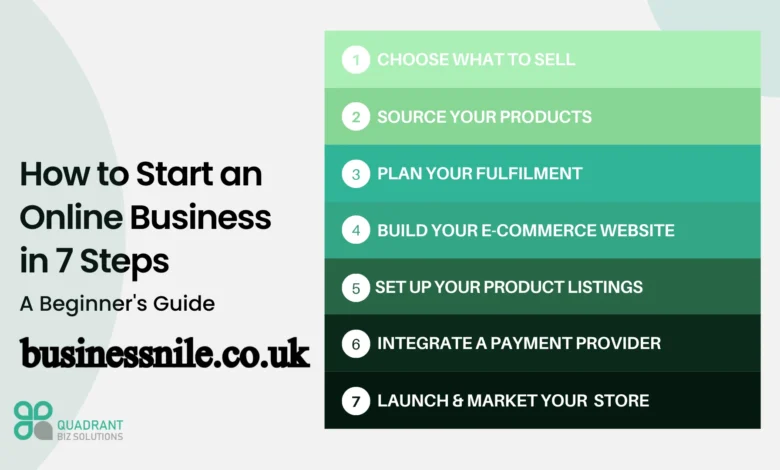
10 Steps to Start an Online Business
1. Conduct Market Research
Market research helps you understand your customers, competitors, pricing, and market demand.
Start by identifying your target market and researching:
- Customer needs
- Customer pain points
- Buying behavior
- Competitor pricing
- Competitor strengths and weaknesses
- Existing solutions
- Market trends
- Search behavior
Competitive analysis is particularly useful because it shows you what customers already have available.
However, do not simply copy competitors. Look for gaps.
For example, perhaps competitors offer good products but poor customer support. That could become your competitive advantage.
2. Identify Your Target Audience
A target audience is the specific group most likely to buy your product or service.
Instead of saying, “My customers are everyone,” define your audience more precisely.
Consider:
- Age
- Location
- Income
- Occupation
- Interests
- Problems
- Buying habits
- Budget
- Preferred platforms
The more clearly you understand your audience, the easier it becomes to create relevant products, content, advertisements, and offers.
3. Choose a Business Model
Your business model explains how the company will make money.
Common online business models include:
| Business Model | How It Makes Money |
|---|---|
| Ecommerce | Selling physical products |
| Dropshipping | Selling products fulfilled by suppliers |
| Freelancing | Charging for professional services |
| Consulting | Charging for expertise and advice |
| Affiliate marketing | Earning commissions from referrals |
| Digital products | Selling ebooks, templates, software, etc. |
| Online courses | Selling educational content |
| Memberships | Charging recurring subscription fees |
| Content business | Monetizing audiences through ads, sponsors, or products |
Choose a model that matches your skills, budget, and desired level of involvement.
stripe.com
4. Create a Business Plan
A business plan does not have to be a 50-page document.
For a small online business, start with a simple plan covering:
- Business idea
- Target market
- Customer problem
- Product or service
- Competitors
- Pricing
- Marketing strategy
- Startup costs
- Business expenses
- Revenue expectations
- Business goals
- Financial projections
Your plan should answer one fundamental question:
How will this business acquire customers and make money?
If you cannot explain that clearly, refine the idea before investing more money.
5. Choose a Business Name and Domain
Choose a name that is:
- Easy to remember
- Easy to spell
- Relevant to your brand
- Flexible enough for future growth
- Available as a suitable domain
Your domain name becomes part of your online identity, so avoid unnecessarily complicated spellings, excessive hyphens, or names that limit you to one product if you plan to expand.
Also check whether the name creates potential trademark problems before investing heavily in branding.
6. Register Your Online Business
Creating a website does not automatically establish your business legally.
In the U.S., your business structure can affect taxation, liability, and filing requirements. Common structures include sole proprietorships, partnerships, corporations, S corporations, and LLCs. The IRS notes that choosing a structure involves both legal and tax considerations.
Depending on your business and location, you may also need:
- State registration
- Local licenses or permits
- Federal or state tax IDs
- An EIN
- Business insurance
- A separate business bank account
Requirements vary by state and business type, so check the relevant state and local authorities rather than assuming one set of rules applies nationwide.
The IRS also recommends considering business structure, EIN requirements, taxes, and recordkeeping when starting a business.
If you need an EIN, the IRS provides an online application, and eligible applicants can obtain one directly from the IRS for free.
7. Build Your Website or Online Store
Your website is often the first major interaction a potential customer has with your business.
A good business website should make it easy for visitors to:
- Understand what you offer
- Learn why they should trust you
- Find important information
- Contact you
- Purchase a product or service
For ecommerce businesses, product pages should include clear descriptions, pricing, images, shipping information, return policies, and an obvious purchase option.
Website Design and User Experience
Keep the design simple and consistent.
Pay attention to:
- Navigation
- Page speed
- Mobile usability
- Readable text
- Clear buttons
- Product images
- Contact information
- Checkout experience
- Brand consistency
A mobile-friendly website is especially important because customers increasingly interact with businesses through smartphones.
8. Set Up Online Payments
If you sell products or services online, customers need a convenient and trustworthy way to pay.
Depending on your business and location, you might offer:
- Credit and debit cards
- Digital wallets
- Bank-based payment methods
- Buy-now-pay-later options where appropriate
Before choosing a payment provider, compare transaction fees, payout timing, supported currencies, fraud protection, customer support, and integration options.
9. Create a Marketing Strategy
Building a website does not guarantee visitors.
You need a marketing plan that answers:
How will potential customers discover my business?
Your strategy could combine:
- Search engine optimization
- Content marketing
- Email marketing
- Social media marketing
- Paid advertising
- Influencer marketing
- Partnerships
- Referral marketing
Do not try every channel simultaneously.
Choose one or two channels where your target audience is already active and learn how to use them effectively.
10. Launch, Measure, and Improve
Your first launch does not have to be perfect.
Start with a minimum viable version of your offer, collect customer feedback, and improve it.
Track useful metrics such as:
- Website visitors
- Leads
- Conversion rate
- Customer acquisition cost
- Average order value
- Revenue
- Profit margin
- Repeat purchases
- Email subscribers
The objective is not simply to generate traffic. It is to determine which activities produce profitable customers.
Best Online Business Ideas to Start
There are many ways to build an online business. Your best choice depends on your skills, capital, and preferred business model.
Ecommerce Business
An ecommerce business sells physical or digital products through an online store. You can manufacture products yourself, purchase inventory, or work with suppliers.
Dropshipping
Dropshipping allows a seller to market products without keeping traditional inventory. When a customer orders, a supplier handles fulfillment.
It can reduce inventory requirements, but margins, supplier reliability, shipping times, and customer service still need careful management.
Affiliate Marketing
Affiliate marketers promote products or services and earn commissions when referred customers complete qualifying actions.
This model works best when you can build an audience through useful content, reviews, comparisons, or educational resources.
Freelancing
Freelancing is one of the simplest service-based models for people with marketable skills.
Examples include:
- Writing
- Graphic design
- Video editing
- Web development
- SEO
- Virtual assistance
- Bookkeeping
- Photography services
Online Courses and Digital Products
You can package knowledge into:
- Courses
- Templates
- Guides
- Ebooks
- Design assets
- Software
- Digital downloads
The advantage is that digital products can often be delivered repeatedly without shipping physical inventory.
Blogging and Content Creation
Bloggers and creators can monetize through advertising, sponsorships, affiliate marketing, memberships, products, or services.
This model usually requires patience because building an audience takes time.
Consulting and Online Services
If you have specialized expertise, consulting can be an attractive option. You can sell one-on-one sessions, packages, retainers, audits, or training.
How Much Does It Cost to Start an Online Business?
There is no universal startup cost.
A service-based business may require little more than a computer, internet connection, website, and software. An ecommerce company may require significantly more for inventory, packaging, shipping, payment processing, and advertising.
Typical expense categories include:
- Domain
- Web hosting
- Website software
- Business registration
- Licenses and permits
- Product inventory
- Payment processing
- Software subscriptions
- Advertising
- Packaging
- Professional services
The important distinction is between minimum launch cost and cost to grow.
You might launch cheaply but later need more money for marketing, inventory, employees, software, or customer acquisition.
Can You Start an Online Business With $100?
Yes, some online businesses can be started with around $100 or less, but your options will be limited.
Service businesses are generally easier to launch with a small budget because you can sell an existing skill instead of purchasing inventory.
For example, you could potentially use a small budget for:
- A domain
- Basic hosting
- A simple website
- Professional email
- Essential software
However, a $100 budget does not guarantee profitability. Your biggest challenge may be acquiring customers rather than creating the website.
A useful strategy is to sell first and scale later. Validate demand before committing significant capital.
How to Create a Website for Your Online Business
How to Choose a Domain Name
Choose something short, memorable, relevant, and easy to pronounce.
Before registering it, check:
- Domain availability
- Social media availability
- Trademark conflicts
- Similar competing names
Choosing Web Hosting
Your hosting provider should offer enough performance, security, support, backups, and scalability for your business.
A simple service website usually has different requirements from a high-volume ecommerce website.
Website Design and User Experience
Your homepage should quickly communicate:
What do you sell? Who is it for? Why should customers choose you?
Then provide an obvious next action, such as:
- Shop now
- Book a consultation
- Get a quote
- Start a free trial
- Contact us
How to Market an Online Business
SEO and Content Marketing
SEO can help your website appear when people search for problems, products, or services related to your business.
Create useful content around:
- Customer questions
- Product comparisons
- Tutorials
- Buying guides
- Problem-solving topics
- Industry information
Focus on satisfying search intent rather than publishing content simply to include keywords.
Social Media Marketing
Social platforms can help businesses build brand awareness, demonstrate products, answer questions, and communicate directly with customers.
Choose platforms based on where your target audience actually spends time.
Email Marketing
Email marketing gives you a direct communication channel with people who have voluntarily subscribed.
Useful emails include:
- Welcome sequences
- Educational content
- Product announcements
- Special offers
- Customer follow-ups
- Abandoned-cart reminders
Paid Advertising
Paid advertising can produce traffic quickly, but it can also consume your budget quickly.
Start with controlled campaigns, measure conversions, and scale only after identifying profitable campaigns.
Influencer Marketing
Influencer partnerships can work particularly well when the creator’s audience closely matches your target customer.
The size of the audience is not everything. Audience relevance and trust can matter more than follower count.
How to Get Your First Online Customers
Getting the first customer is often harder than creating the website.
Start with people who have a genuine reason to need your product or service.
Create Effective Calls to Action
Tell visitors exactly what to do next.
Examples:
- Get a quote
- Shop the collection
- Book a call
- Download the guide
- Start today
Use Customer Reviews and Testimonials
Authentic reviews can reduce uncertainty and help potential buyers understand the experience of using your product or service.
Never manufacture testimonials or misleading reviews.
Optimize Your Website for Conversions
Look for friction in the customer journey.
Ask:
- Is the offer immediately understandable?
- Is the price easy to find?
- Can customers contact you easily?
- Is checkout simple?
- Are shipping and returns clear?
- Does the website work properly on mobile?
Small improvements can sometimes have a greater impact than simply increasing traffic.
Common Online Business Mistakes to Avoid
New entrepreneurs often make the same mistakes.
1. Choosing an Idea Without Validating Demand
Being passionate about something does not automatically mean there is a profitable market.
2. Spending Too Much Too Early
Avoid purchasing expensive software, inventory, or advertising before validating your business model.
3. Trying to Sell to Everyone
A specific target market is usually easier to understand and reach.
4. Ignoring Customer Feedback
Customers can reveal problems that you cannot see from inside the business.
5. Focusing Only on Traffic
Thousands of visitors are not useful if nobody buys.
6. Neglecting Financial Records
Track revenue and business expenses from the beginning.
7. Ignoring Legal and Tax Requirements
Online does not mean exempt from business regulations. U.S. requirements can vary by structure, state, locality, and industry. The SBA specifically advises businesses to consider registration, tax IDs, licenses, permits, banking, and insurance.
Is Starting an Online Business Worth It?
It can be, provided you treat it like a real business rather than a shortcut to easy money.
The online model offers advantages such as lower overhead for some business types, access to broader markets, and the ability to operate remotely.
But competition is significant. Success generally depends on having a valuable offer, reaching the right audience, controlling costs, providing good customer experiences, and continuously improving.
For U.S. sellers, current e-commerce data shows that online retail remains a substantial part of the broader retail market. In Q2 2026, e-commerce accounted for 17.1% of total U.S. retail sales.
That makes the opportunity real—but opportunity alone does not create a profitable company.
Frequently Asked Questions About Starting an Online Business
How to start an online business from home?
Choose a business idea, validate demand, identify your target audience, select a business model, create a simple business plan, handle applicable registration requirements, build an online presence, set up payments, and begin marketing. Service businesses are often easier to operate from home because they may not require inventory or physical premises.
How to start an online business with no money?
Start with a service based on a skill you already have. Freelancing, consulting, writing, design, tutoring, and some forms of content creation can have relatively low startup costs. Instead of buying inventory, focus first on finding a customer and generating revenue.
How to start online business from home for free?
You can begin by offering a service through existing platforms, creating free social media profiles, producing useful content, and contacting potential customers directly. However, a completely free business may have limitations. A professional domain, website, software, or payment system may eventually require some investment.
How to start an online business as a teenager?
A teenager can explore low-cost models such as content creation, tutoring, digital products, or certain freelance services. However, age-related requirements can affect contracts, payment accounts, business registration, and platform eligibility. Parents or guardians may need to be involved depending on the situation and jurisdiction.
How to start an online business as a kid for free?
Start by learning a marketable skill and creating a simple project around it, such as educational content, art, or a supervised service. Because minors may face restrictions on contracts and financial accounts, involve a parent or guardian and check the applicable rules before accepting payments.
I want to start an online business but have no ideas. What should I do?
Start with problems rather than products. List your skills, interests, work experience, and problems you understand well. Then research whether people already pay for solutions to those problems. You can also examine customer complaints in reviews and online communities to identify opportunities.
How to start an online business selling products?
Choose a product category, research demand and competitors, determine your sourcing or manufacturing method, calculate costs and profit margins, choose a business structure, register where required, create an ecommerce website, set up payments and fulfillment, and develop a marketing strategy.
How to start an online business as a teenager with no money?
A teenager with no money can begin by developing and selling a skill, such as writing, editing, tutoring, design, or content creation. Start with free tools where possible and reinvest early earnings. Because minors can face restrictions on contracts, payment services, and business accounts, get appropriate adult guidance before accepting payments or signing agreements.
The Bottom Line
Learning how to start an online business is less about finding a secret business idea and more about building a repeatable system.
Start small. Find a specific customer problem, validate your idea, choose a suitable business model, establish the business properly, create a useful website, and focus on acquiring your first customers.
Once you have evidence that people will pay for your offer, reinvest carefully into marketing, customer experience, technology, and business growth.
The strongest online businesses are not necessarily those that launch with the biggest budget. They are the ones that understand their customers, deliver genuine value, manage their finances, and improve consistently.
Author Bio: Hamid Ali is a business and SEO writer specializing in online business, entrepreneurship, and digital marketing. He creates practical, easy-to-understand guides to help entrepreneurs build and grow successful online businesses.
Also Read: