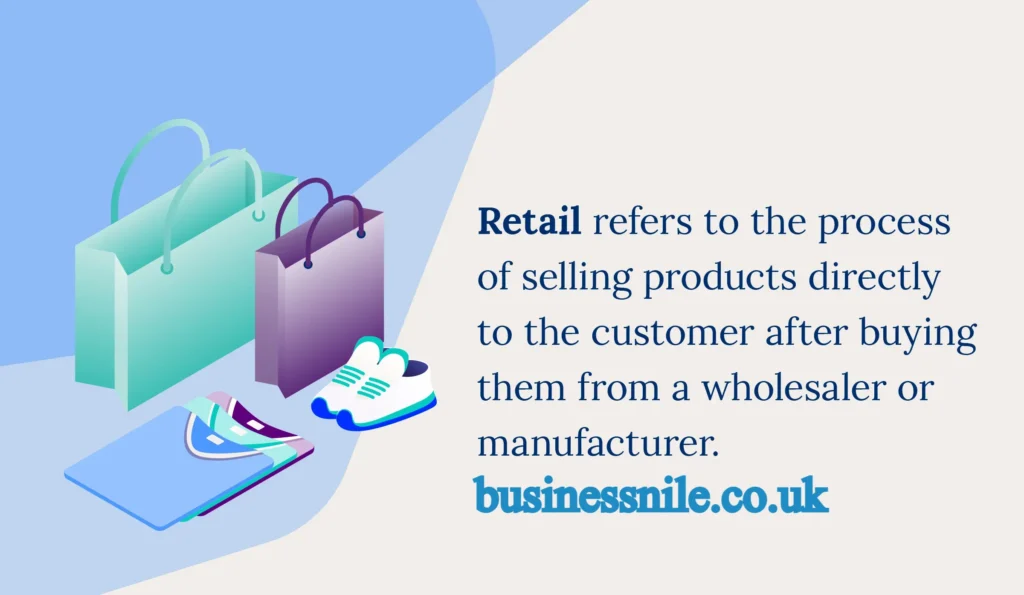
Retail is the process of selling products or services directly to the final customer for personal, household, or everyday use. A retailer may operate through a physical store, website, mobile app, marketplace, or a combination of channels.
When you buy groceries from Walmart, order shoes from an online store, purchase a phone from Best Buy, or buy clothing from a local shop, you are participating in retail.
The U.S. Census Bureau describes retail trade as businesses that sell merchandise in relatively small quantities to the general public, generally without transforming the products. It recognizes both store-based and nonstore retailers.
In simple terms:
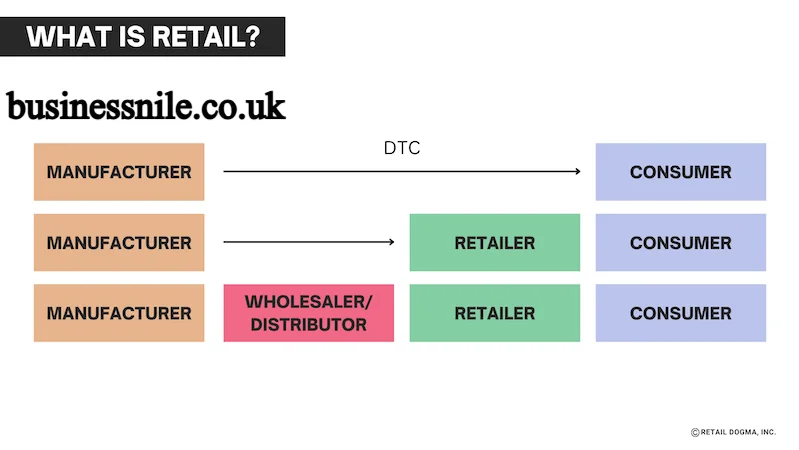
Manufacturer → Wholesaler → Retailer → Consumer
However, modern retail is more flexible. A brand can manufacture a product and sell it directly through its own website, eliminating the traditional wholesaler or retailer.
This guide explains the retail meaning, retail business model, types of retail stores, supply chain, pricing, profits, technology, marketing, and customer experience.
What Does Retail Mean?
Retail means selling goods or services to people who will ultimately use them rather than resell them.
For example:
- A grocery store selling food to a family is retail.
- A clothing website selling a jacket to an individual is retail.
- A pharmacy selling medicine to a customer is retail.
- An electronics store selling a laptop to a student is retail.
- A salon selling a haircut directly to a customer is a retail service.
The key difference is the end consumer.
A retailer can sell through a physical location or digitally. The U.S. Census Bureau separates retail businesses into store and nonstore retailers, with ecommerce included among nonstore methods.
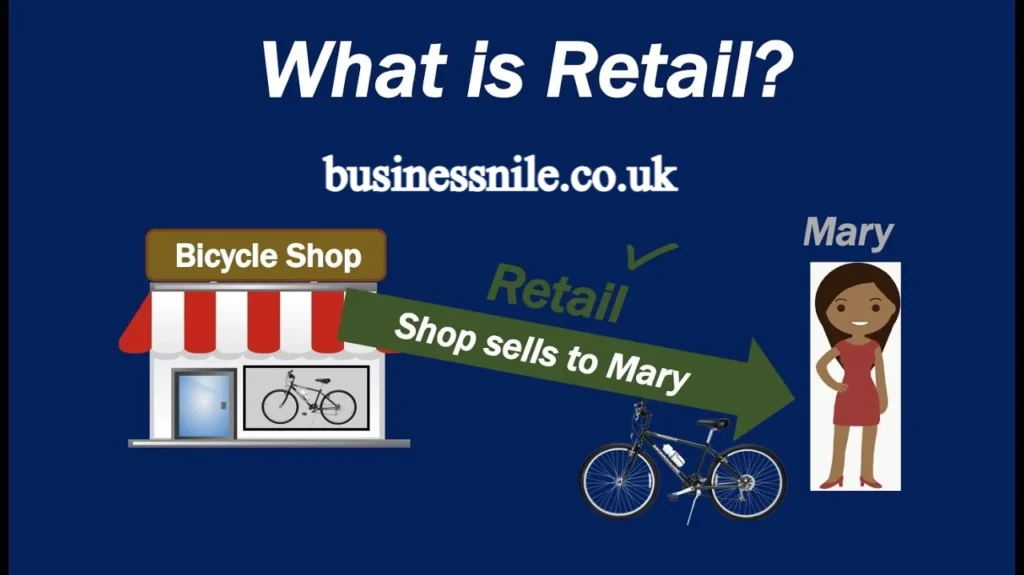
What is a retailer?
A retailer is a business that sells products or services directly to consumers.
Retailers typically handle activities such as:
- Selecting products
- Buying or sourcing inventory
- Setting prices
- Marketing products
- Managing inventory
- Processing payments
- Providing customer service
- Handling returns and exchanges
- Delivering products
- Building customer loyalty
Examples of major U.S. retailers include Walmart, Amazon, Costco, Target, The Home Depot, and Kroger. The National Retail Federation’s 2025 Top 100 list ranked Walmart first by 2024 U.S. retail sales, followed by Amazon and Costco Wholesale.
Retail vs Wholesale: What’s the Difference?
The simplest distinction is who buys the product and why.
| Retail | Wholesale |
|---|---|
| Sells mainly to consumers | Sells mainly to businesses |
| Usually sells smaller quantities | Usually sells larger quantities |
| Products are often purchased for personal use | Products may be purchased for resale or business use |
| Higher per-unit price is common | Lower per-unit price is common |
| Focuses heavily on customer experience | Focuses heavily on business relationships |
| Examples: Walmart, Target, online stores | Examples: distributors and bulk suppliers |
What is retail and wholesale?
Retail and wholesale are different stages of product distribution.
Suppose a manufacturer produces 10,000 shirts. A wholesaler might purchase thousands of shirts and distribute them to several retailers. A retailer then sells individual shirts to customers.
However, the traditional model isn’t mandatory. Some brands now use a direct-to-consumer (DTC) model and sell directly through their own websites or stores.
What Are the Main Types of Retail Businesses?
Retail businesses come in many forms. Some focus on variety, while others specialize in one product category or sell entirely online.
1. Department Stores
Department stores sell products across multiple categories in one location.
Typical departments may include:
- Clothing
- Shoes
- Beauty products
- Home goods
- Electronics
- Accessories
The major advantage is convenience. Customers can find many different types of products without visiting several separate stores.
2. Discount Stores
Discount stores compete primarily through affordable prices and high sales volumes.
Examples include Walmart, Target, and Dollar General.
Their business model often depends on efficient purchasing, inventory management, distribution, and relatively low operating costs.
3. Specialty Stores
Specialty retailers concentrate on a particular category.
Examples include:
- Electronics stores
- Sporting goods stores
- Furniture stores
- Bookstores
- Jewelry stores
- Beauty retailers
Specialty stores can compete through deeper product selection and knowledgeable customer service.
4. Online Retail Stores
Online retail allows customers to purchase products through websites and apps.
Common examples include:
- Amazon
- Brand-owned ecommerce stores
- Online fashion retailers
- Digital marketplaces
Online retail provides convenience, broader geographic reach, and 24-hour shopping access.
The Census Bureau defines an ecommerce transaction based on where the buyer places the order or negotiates the sale through an electronic system such as the internet.
5. Independent Retail Stores
Independent stores are usually owned and operated by individuals, families, or small businesses.
Examples include:
- Local clothing boutiques
- Neighborhood grocery stores
- Independent bookstores
- Gift shops
- Specialty food stores
These businesses often compete through personal service, local knowledge, unique products, and community relationships.
How Does the Retail Supply Chain Work?
The retail supply chain describes how products move from their source to the customer.
A simplified process looks like this:
Manufacturer → Distributor/Wholesaler → Retailer → Customer
However, some businesses use a shorter route:
Manufacturer → Customer
This is common in direct-to-consumer ecommerce.
1. Manufacturer
The manufacturer produces the product and prepares it for distribution.
2. Wholesaler or Distributor
A wholesaler may purchase products in bulk and sell them to retailers.
3. Logistics
Transportation and logistics providers move products between facilities, warehouses, stores, and customers.
4. Retailer
The retailer purchases or receives inventory, promotes it, sets prices, and makes it available to customers.
5. Consumer
The customer purchases the product and becomes the final user.
The retail supply chain therefore involves much more than a store shelf. Inventory planning, transportation, warehousing, purchasing, and delivery all affect whether the right product reaches the customer at the right time.
How Do Retailers Make Money?
Retailers generally make money by selling products or services for more than their total cost of acquiring and selling them.
A basic example:
- Retail purchase cost: $40
- Selling price: $60
- Gross profit before other costs: $20
The $20 difference is not necessarily the retailer’s final profit.
The retailer may still need to pay for:
- Rent
- Employee wages
- Advertising
- Shipping
- Utilities
- Software
- Payment processing
- Insurance
- Returns
- Storage
- Taxes
- Other operating expenses
What is retail markup?
Retail markup is the amount added to the product’s cost to establish its selling price.
For example, if a store buys an item for $50 and sells it for $75, the dollar markup is $25.
Markup and profit margin are related but not the same calculation. Understanding this distinction is important when evaluating retail pricing and profitability.
Retail pricing strategy
Retailers may consider several factors when setting prices:
- Product cost
- Competitor prices
- Customer demand
- Brand positioning
- Operating expenses
- Inventory levels
- Seasonal demand
- Promotions and discounts
- Customer willingness to pay
A successful retailer doesn’t necessarily have the lowest price. The goal is to establish a price that customers consider worthwhile while leaving enough margin to operate profitably.
What Makes a Retail Business Successful?
A successful retail business combines the right products with efficient operations and a strong customer experience.
Five areas are especially important.
1. Product selection
Retailers need to understand what customers actually want to purchase.
Selling too little variety can limit sales, while carrying too much inventory can tie up cash.
2. Inventory management
Inventory management means monitoring what is available, what is selling, and when new stock is needed.
Good inventory management can help prevent:
- Stockouts
- Excess inventory
- Expired products
- Overstocking
- Lost sales
- Unnecessary storage costs
3. Customer experience
Customers judge more than the product itself.
They may consider:
- Store layout
- Website usability
- Product information
- Checkout speed
- Delivery
- Staff behavior
- Return policies
- Customer support
A convenient and reliable shopping experience can encourage repeat purchases and customer loyalty.
4. Competitive pricing
Prices should reflect costs, market conditions, customer expectations, and the retailer’s positioning.
Discounting everything may increase sales temporarily but can damage margins if it is not carefully managed.
5. Consistent service
Whether customers interact with a store employee, website, chatbot, or delivery team, the experience should feel connected.
What Is the Retail Marketing Mix?
The traditional retail marketing mix is based on the 4Ps: Product, Price, Place, and Promotion.
Product
Offer products that solve a genuine customer need.
Price
Set prices that balance customer value, competition, costs, and profitability.
Place
Make products available where customers prefer to shop, whether that means a physical store, website, app, marketplace, or several channels.
Promotion
Use marketing methods such as:
- Search advertising
- Social media
- Email marketing
- Content marketing
- Discounts
- Loyalty programs
- Influencer marketing
- In-store promotions
The strongest retail marketing strategy connects these four elements rather than treating advertising as a separate activity.
How Is Technology Changing Retail?
Technology has changed how retailers sell, manage inventory, understand customers, and process transactions.
Point-of-Sale Systems
A point-of-sale (POS) system handles transactions and can do much more than process payments.
Modern POS systems may help retailers:
- Track sales
- Update inventory
- Process returns
- Manage discounts
- Collect customer information
- Monitor product performance
- Generate reports
Retail Software
Retail management software can bring different business functions together.
Depending on the system, retailers may use it for:
- Inventory management
- Sales tracking
- Customer relationship management
- Marketing
- Loyalty programs
- Order management
- Reporting
- Ecommerce
- Employee management
The main benefit is better visibility. Instead of making decisions based entirely on guesswork, retailers can use sales and customer data to identify trends.
What Is Omnichannel Retail?
Omnichannel retail means connecting multiple shopping channels so customers can interact with the same retailer across different platforms.
For example, a customer might:
- Discover a product on social media.
- Research it on the retailer’s website.
- Check store availability.
- Buy it online.
- Pick it up at a physical store.
- Return it through another channel.
The customer experiences one brand rather than several disconnected systems.
This is increasingly important because shopping behavior can move between online and offline environments.
Retail Business Tips for Beginners
If you’re starting a retail business, focus on the fundamentals before adding unnecessary complexity.
1. Know your target customer
Identify who you are selling to, what they need, and how much they are willing to spend.
2. Start with controlled inventory
Avoid putting too much money into products before you know what sells.
3. Calculate your real costs
Don’t look only at the purchase price. Include shipping, storage, marketing, payment fees, returns, rent, wages, and other expenses.
4. Make checkout simple
Whether you’re operating online or in-store, unnecessary friction can cause customers to abandon a purchase.
5. Build an online presence
Even a physical retailer can benefit from a website, Google Business Profile, social media, and online product information.
6. Track your numbers
Monitor:
- Revenue
- Gross profit
- Average order value
- Inventory turnover
- Conversion rate
- Return rate
- Customer acquisition cost
- Repeat purchases
7. Learn from returns
Returns can reveal problems with product quality, sizing, descriptions, expectations, or customer targeting.
8. Reward loyal customers
Loyalty programs, personalized offers, excellent service, and relevant communication can encourage customers to return.
Why Is the Retail Industry Important?
Retail connects products with the people who ultimately use them. It also influences manufacturers, logistics providers, technology companies, advertisers, landlords, and other parts of the economy.
In the United States, the National Retail Federation’s March 2026 forecast projected 2026 retail sales of about $5.6 trillion, representing expected growth of 4.4% from 2025 under its definition of retail sales.
The number is useful as an indication of the scale of the U.S. market, but it is important to understand that industry organizations can use definitions that differ from government statistical programs. For example, NRF’s core retail-sales definition excludes automotive dealers, gasoline stations, and restaurants.
The broader lesson is that retail remains a huge and evolving part of the economy, with online and physical shopping increasingly working together.
What Is Retail? Key Takeaway
So, what is retail?
Retail is the process of selling products or services directly to consumers for their use. It can happen through a traditional store, ecommerce website, mobile app, marketplace, or a combination of channels.
A retailer’s job goes far beyond simply selling products. Successful retail requires:
- The right products
- Smart pricing
- Reliable inventory management
- Efficient supply chains
- Strong marketing
- Convenient checkout
- Helpful customer service
- Useful technology
- A consistent shopping experience
The modern retail business is therefore a combination of commerce, technology, marketing, operations, and customer relationships.
Frequently Asked Questions
What is retail job?
A retail job is a position involving the sale of products or services directly to customers. Common retail jobs include sales associate, cashier, store manager, customer service representative, inventory associate, visual merchandiser, and retail buyer.
What is retail management?
Retail management is the process of operating and controlling a retail business. It can include staff management, inventory, sales, customer service, merchandising, pricing, store operations, and performance tracking.
What is retail industry?
The retail industry consists of businesses that sell merchandise and related services to the general public. In the U.S., the Census Bureau classifies Retail Trade under NAICS sectors 44–45 and distinguishes between store and nonstore retailers.
What is retail examples?
Examples of retail include buying groceries from a supermarket, purchasing clothes from a department store, ordering electronics online, buying furniture from a retailer, or purchasing cosmetics from a specialty store.
What is retail business?
A retail business sells products or services directly to final customers. It may operate through physical stores, ecommerce, mobile applications, marketplaces, or multiple channels.
What is retail price?
A retail price is the amount a customer is charged for a product or service. Retailers generally set prices by considering product costs, competition, demand, customer value, operating expenses, and desired profitability.
What is retail store?
A retail store is a physical location where a business sells products directly to customers. Examples include grocery stores, clothing stores, electronics stores, pharmacies, department stores, and specialty shops.
What is retail and wholesale?
Retail sells primarily to final consumers in smaller quantities, while wholesale generally sells larger quantities to businesses, retailers, or other organizations. The U.S. Census Bureau defines retailers as businesses that sell goods in small quantities directly to consumers.
Author Bio: Hamid Ali is a business and digital marketing writer covering retail, ecommerce, finance, and emerging business trends. He focuses on creating clear, practical, and research-driven content that helps readers understand complex topics.
Author Name: Hamid Ali
Email: johanharwen314@gmail.com
Also Read: