
Introduction
If you’re wondering when is the stock market open, the answer depends on which exchange you want to trade. In the United States, the regular trading session for the New York Stock Exchange (NYSE) and Nasdaq runs from 9:30 a.m. to 4:00 p.m. Eastern Time, Monday through Friday, except on scheduled market holidays and early-close days.
However, the U.S. market is only one part of the global financial system. London, Tokyo, Shanghai, Hong Kong, Mumbai, Sydney, Johannesburg, São Paulo and Riyadh all follow their own exchange operating hours and holiday calendars.
Knowing these schedules can help investors understand when liquidity is highest, when markets overlap and when an order can actually execute.
U.S. stocks normally trade from 9:30 a.m. to 4:00 p.m. ET, Monday through Friday. Pre-market and after-hours trading can extend the trading day, but those sessions can have lower liquidity and higher volatility.

Stock Market Trading Hours: Key Takeaways
The most important stock market trading hours to remember are:
- NYSE: 9:30 a.m.–4:00 p.m. ET
- Nasdaq: 9:30 a.m.–4:00 p.m. ET
- Nasdaq pre-market: 4:00–9:30 a.m. ET
- Nasdaq after-hours: 4:00–8:00 p.m. ET
- Most major exchanges operate Monday through Friday.
- International exchanges use their own local time zones and holiday calendars.
- Some Asian markets have a midday lunch break.
- Saudi Exchange trades Sunday through Thursday rather than Monday through Friday.
- U.S. exchanges close for major holidays and sometimes close early before or after holidays.
One important distinction: an online broker may accept an order while an exchange is closed, but that does not necessarily mean the order executes immediately. The order may wait for the next eligible trading session unless the broker supports extended-hours trading.
What Time Does the Stock Market Open?
For investors trading U.S.-listed stocks, the regular market opens at 9:30 a.m. Eastern Time.
Both NYSE and Nasdaq have regular sessions from 9:30 a.m. to 4:00 p.m. ET, Monday through Friday.
This six-and-a-half-hour period is generally what people mean when they refer to normal or regular trading hours.
The opening of the market can be particularly important because overnight news, earnings announcements and economic data can affect prices when trading resumesWhat Time Does the Stock Market Close?
The regular U.S. stock market closes at 4:00 p.m. ET on normal trading days.
That applies to the primary Nasdaq Stock Market session and the NYSE’s core trading session. NYSE identifies its core session as 9:30 a.m. to 4:00 p.m. ET.
The close does not necessarily mean that all electronic trading activity stops. Extended-hours sessions can continue for certain securities and through participating brokers.
Trading Hours by Region
Global stock exchanges don’t share one universal schedule. Their hours are determined by local business practices, regulations, time zones and market structure.
Here’s a useful overview.
| Region / Exchange | Regular Trading Hours | Local Time |
|---|---|---|
| NYSE | 9:30 a.m.–4:00 p.m. | U.S. Eastern Time |
| Nasdaq | 9:30 a.m.–4:00 p.m. | U.S. Eastern Time |
| London Stock Exchange | Around 8:00 a.m.–4:30 p.m. | London time |
| Tokyo Stock Exchange | 9:00–11:30 a.m.; 12:30–3:30 p.m. | Japan time |
| Shanghai Stock Exchange | 9:30–11:30 a.m.; 1:00–3:00 p.m. | China time |
| Hong Kong Exchange | 9:30 a.m.–4:00 p.m. | Hong Kong time |
| NSE India | 9:15 a.m.–3:30 p.m. | India time |
| Saudi Exchange | 10:00 a.m.–3:00 p.m. | Saudi Arabia time |
| ASX | Around 10:00 a.m.–4:00 p.m. | Sydney time |
| Johannesburg Stock Exchange | Generally during South African business hours | South Africa time |
Exact sessions can differ by product, auction period and exchange calendar, so investors should check the individual exchange before trading.
North American Stock Exchanges
The NYSE and Nasdaq dominate U.S. equity trading, and both have regular hours of 9:30 a.m. to 4:00 p.m. ET.
The Mexican Stock Exchange and Toronto market operate in different local time zones but broadly align with North American trading activity.
For U.S. investors, Eastern Time is the key reference point.
U.K. and European Stock Exchanges
The London market’s main trading schedule is generally associated with 8:00 a.m. to 4:30 p.m. London time. London Stock Exchange Group information also identifies 8:00 a.m. to 4:30 p.m. as the continuous trading period for its Turquoise venue.
European exchanges operate according to their own local calendars. Euronext, for example, operates markets across multiple European countries, meaning local holidays and specific products can affect schedules.
Asian and Middle Eastern Stock Exchanges
Asian markets are particularly important when considering global stock market hours because they begin trading while North America is still closed.
The Tokyo Stock Exchange has two main cash-equity sessions:
- Morning: 9:00–11:30 a.m.
- Afternoon: 12:30–3:30 p.m.
That means Tokyo has a one-hour lunch break between regular sessions.
The Shanghai Stock Exchange’s 2026 trading rules specify continuous auction trading from 9:30–11:30 a.m. and 1:00–2:57 p.m., followed by a closing auction through 3:00 p.m.
Hong Kong’s securities market has morning and afternoon trading sessions, with continuous trading from 9:30 a.m. to noon and 1:00 p.m. to 4:00 p.m., plus auction periods.
Saudi Arabia is another important exception to the typical Monday-Friday pattern. The Saudi Exchange operates Sunday through Thursday, with the regular market trading session from 10:00 a.m. to 3:00 p.m. local time.
South American Stock Exchanges
Brazil’s B3 is the largest stock exchange in South America. Its trading schedule varies by market segment and product, so investors should consult B3’s current trading calendar rather than assume one universal opening and closing time. B3’s official materials show different schedules for equities, fixed income and derivatives.
African Stock Exchanges
The Johannesburg Stock Exchange is the major equity market in Africa. Its trading environment also includes separate markets and products, so the exact schedule depends on what is being traded.
The important point for international investors is that South African markets operate on South African time rather than U.S. or European time.
Australian and Oceania Stock Exchanges
The Australian Securities Exchange (ASX) is Australia’s primary stock exchange. ASX publishes separate trading schedules for cash equities, options, derivatives and other products, so investors should use the exchange’s current calendar when planning trades.
U.S. Stock Market Holidays in 2026
The NYSE and Nasdaq do not operate on every weekday. Major U.S. market holidays can result in a full closure, while some sessions have an early close.
For 2026, major U.S. stock-market closures include:
| Holiday | 2026 Date | Status |
|---|---|---|
| New Year’s Day | Jan. 1 | Closed |
| Martin Luther King Jr. Day | Jan. 19 | Closed |
| Presidents Day | Feb. 16 | Closed |
| Good Friday | Apr. 3 | Closed |
| Memorial Day | May 25 | Closed |
| Juneteenth | June 19 | Closed |
| Independence Day observed | July 3 | Closed |
| Labor Day | Sept. 7 | Closed |
| Thanksgiving Day | Nov. 26 | Closed |
| Christmas Day | Dec. 25 | Closed |
The NYSE also lists early closes at 1:00 p.m. ET on Nov. 27, 2026, the Friday after Thanksgiving, and Dec. 24, 2026, Christmas Eve.
Nasdaq’s 2026 calendar confirms the same major U.S. closures and early closes.
Is the Stock Market Open Today?
Today, Monday, September 7, 2026, the U.S. stock market is closed for Labor Day. The NYSE and Nasdaq holiday calendars list Labor Day as a market closure.
Regular U.S. equity trading resumes on Tuesday, September 8, 2026, assuming no extraordinary market closure.
This is a good example of why checking the calendar matters: a Monday is normally a trading day, but a market holiday can completely change the schedule.

U.S. Stock Market Holidays in 2027
The NYSE’s published calendar lists these major 2027 closures:
- New Year’s Day — Jan. 1
- Martin Luther King Jr. Day — Jan. 18
- Washington’s Birthday — Feb. 15
- Good Friday — Mar. 26
- Memorial Day — May 31
- Juneteenth observed — June 18
- Independence Day observed — July 5
- Labor Day — Sept. 6
- Thanksgiving Day — Nov. 25
- Christmas Day observed — Dec. 24
The NYSE also schedules an early close at 1:00 p.m. ET on Nov. 26, 2027, the day after Thanksgiving.
Pre-Market and After-Hours Trading
Regular market hours aren’t the entire U.S. trading day.
Nasdaq currently lists its pre-market session from 4:00 a.m. to 9:30 a.m. ET and its after-hours session from 4:00 p.m. to 8:00 p.m. ET. However, broker availability can differ.
What Is Pre-Market Trading?
Pre-market trading occurs before the regular 9:30 a.m. ET opening.
Investors may use it to respond to:
- Earnings reports
- Economic announcements
- Company news
- Overnight developments
- International market moves
But pre-market trading can have lower liquidity and wider spreads, making price movements potentially more volatile.
What Is After-Hours Trading?
After-hours trading takes place after the regular 4:00 p.m. close.
It can be useful when companies release earnings after the regular session. However, fewer market participants may mean less liquidity and potentially greater price fluctuations.
Your broker determines which extended-hours services are available to you.
Which Stock Exchanges Have Lunch Breaks?
Not every exchange trades continuously throughout its regular session.
Tokyo, for example, stops regular cash-equity trading from 11:30 a.m. to 12:30 p.m. local time.
Shanghai also separates its trading day into morning and afternoon sessions.
Hong Kong has a midday break between its morning and afternoon continuous-trading periods.
These breaks are an important part of international trading sessions and demonstrate why simply converting New York’s hours to another country can sometimes be misleading.
Stock Exchange vs. Stock Market
A stock exchange is an organized marketplace where securities can be listed and traded under defined rules.
The phrase stock market is broader. It can refer to the overall marketplace for stocks or a country’s equity markets collectively.
For example:
- NYSE = a specific stock exchange
- Nasdaq = a specific stock exchange and market operator
- U.S. stock market = broader term covering the U.S. equity marketplace
- Global stock market = collective term for equity markets around the world
Understanding this distinction helps when searching for stock exchange hours because different exchanges can have different schedules.
What Is a Stock Market Circuit Breaker?
A circuit breaker is a mechanism designed to temporarily restrict or halt trading during periods of extreme market movement.
Circuit breakers are different from normal market closing times. They can interrupt trading unexpectedly when predefined volatility conditions are reached.
In the U.S., the Limit Up-Limit Down system is designed to prevent trades in covered securities from occurring outside specified price bands during regular trading hours.
For investors, the practical lesson is simple: market hours tell you when trading is normally available, but extraordinary volatility can temporarily change what happens during those hours.
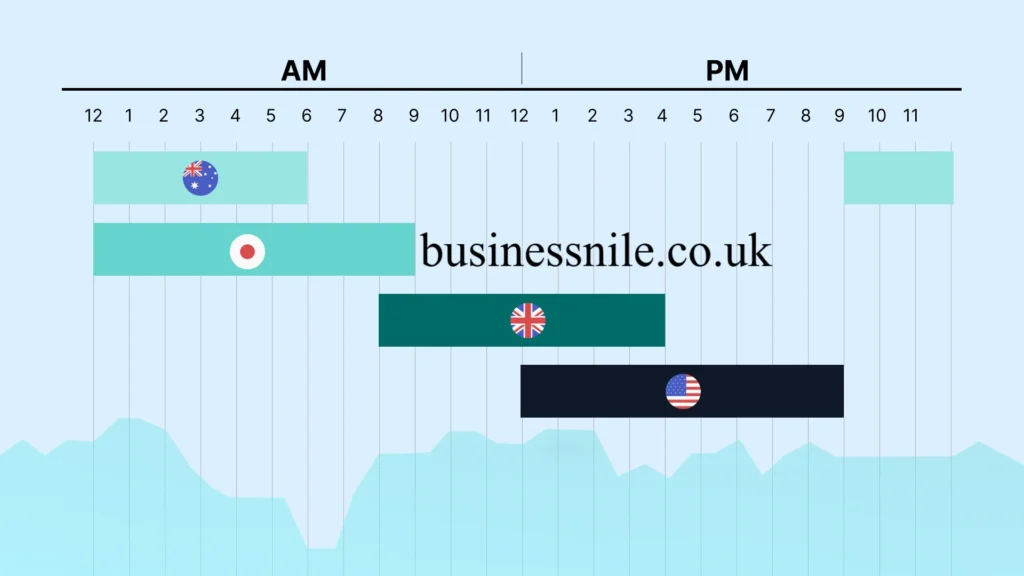
How Stock Market Time Zones Affect Investors
Global markets operate across multiple time zones, creating a nearly continuous sequence of trading activity.
For example, Asian markets can be active before European markets open, while European trading overlaps with part of the U.S. session.
This creates periods when several major markets are active simultaneously.
For international investors, this can matter because:
- News can move from one region to another.
- Currency markets operate across global time zones.
- Overnight movements can influence the next market’s opening.
- Trading volume can increase during overlapping sessions.
- Economic announcements may affect multiple markets at once.
Instead of asking only “when is the stock market open?”, active investors should ask which market is open and which markets are overlapping at that time?
When Is the Best Time to Trade Stocks?
There is no single best time for every investor or strategy.
For U.S. stocks, the opening and closing portions of the regular session often attract significant trading activity. The middle of the session can be quieter for some stocks, although volume varies by company, news and market conditions.
Rather than assuming one time is always superior, investors should consider:
- Liquidity
- Bid-ask spreads
- Volatility
- News releases
- Earnings announcements
- Trading strategy
- Individual risk tolerance
For long-term investors, the exact minute of a purchase may be much less important than maintaining a disciplined investment strategy.
Stock Market Trading Hours FAQs
What time does the stock market open?
The U.S. stock market’s regular session opens at 9:30 a.m. Eastern Time, Monday through Friday, for NYSE and Nasdaq-listed stocks, except scheduled market holidays and special closures.
What time does the stock market close?
The regular NYSE and Nasdaq stock-market session closes at 4:00 p.m. Eastern Time on normal trading days.
Is the stock market open on holidays?
Generally, no. Major U.S. exchanges close on designated market holidays such as New Year’s Day, Thanksgiving, Christmas and Labor Day. Some holidays or surrounding days can instead have shortened trading sessions.
Which stock exchanges are open on weekends?
Most major stock exchanges are closed on Saturdays and Sundays. One notable exception is the Saudi Exchange, whose listed-securities trading week runs Sunday through Thursday, excluding official Saudi holidays.
Do international stock markets have different trading hours?
Yes. International exchanges use different local schedules, time zones, holidays and session structures. Tokyo, Shanghai and Hong Kong, for example, have midday breaks, while the NYSE and Nasdaq operate continuously during their regular 9:30 a.m.–4:00 p.m. ET sessions.
Final Takeaway
If you’re asking when is the stock market open in the United States, remember the simplest answer: NYSE and Nasdaq are normally open from 9:30 a.m. to 4:00 p.m. ET, Monday through Friday.
But global investing requires more than knowing U.S. hours. Every major exchange has its own schedule, holidays and sometimes lunch breaks. Extended-hours trading can provide additional opportunities, but it can also involve lower liquidity and greater volatility.
For the most accurate schedule, always check the official calendar of the exchange where the security is listed before placing a trade.
About the Author: Hamid Ali is a finance and investing content writer specializing in stock markets, trading hours, and financial education. He creates clear, accurate, and reader-friendly guides that help investors understand global markets.
Author Name: Hamid Ali
Email: johanharwen312@gmail.com
Also Read:
- How to Invest in the Stock Market with Little Money in the USA
- What Time Does the Stock Market Open?
- Monthly Dividend Stocks