Introduction
You have probably seen someone online bragging about making thousands of dollars using AI tools without doing the actual work themselves. That is not a scam story. It is a real business model called AI arbitrage, and it is quietly changing how people earn money online. So what is AI arbitrage exactly? In simple terms, AI arbitrage is the practice of using AI tools to deliver services faster or at a lower cost than traditional methods, while pocketing the profit from that difference.
Think of it like buying low and selling high, except instead of stocks or products, you are trading speed and efficiency. This article breaks down everything you need to know about AI arbitrage. You will learn how it works, whether it is legal, how much you can realistically earn, and the tools people use to get started. By the end, you will know if AI arbitrage fits your goals.
What Is AI Arbitrage in Simple Terms
Let us slow down and explain AI arbitrage like you are hearing it for the first time. Traditional service businesses charge high prices because they rely on human labor. A logo design might take a designer three hours. A blog post might take a writer half a day.
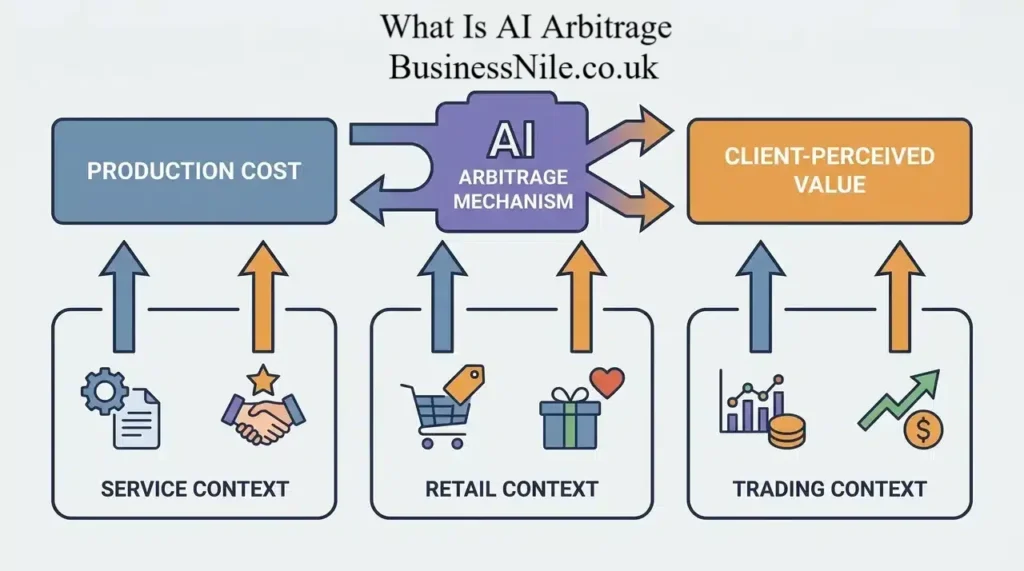
AI arbitrage flips that model. You use AI tools to complete the same task in minutes, then sell it at a price close to the traditional market rate. The gap between what AI costs you and what the client pays you is your profit margin.
This is not new thinking. It is the same logic used in financial arbitrage, where traders buy an asset cheap in one market and sell it higher in another. AI arbitrage simply applies that idea to services and digital products.
How Does AI Arbitrage Work
AI arbitrage works through a simple three step cycle that repeats itself with every client or project.
- You identify a service people already pay for. This could be content writing, video editing, graphic design, customer support, or even bookkeeping.
- You use AI tools to complete that service faster and cheaper. Instead of hiring a full team, you let AI handle most of the heavy lifting.
- You sell the final result at or near the market price. The client gets quality work. You keep the difference between your low AI cost and the price you charged.
Here is a quick example. Say a client wants ten blog posts and normally pays a freelance writer 500 dollars for that batch. Using an AI writing tool plus your own editing skills, your cost might be closer to 50 dollars in tool subscriptions and your time. You still charge the client 400 or 500 dollars. That gap is pure arbitrage profit.
The key skill here is not writing or designing. It is knowing how to guide AI tools to produce work that looks professionally done, then adding your own polish on top.
Is AI Arbitrage Legal in the USA
Yes, AI arbitrage is completely legal in the United States. There is no law against using AI tools to complete client work faster or cheaper. Freelancers and agencies have used shortcuts, templates, and outsourcing for decades, and AI is simply the newest tool in that toolbox.
That said, legality comes with a few responsibilities you should not ignore.
- Always deliver work that meets the quality your client expects.
- Disclose AI usage if your contract or platform requires it.
- Avoid copying content directly from AI without checking for accuracy or plagiarism.
- Follow tax rules for any income you earn, just like any other business.
Being legal does not mean being reckless. Clients care about results, not how you produced them, but honesty builds trust and keeps your business protected long term.
Is AI Arbitrage Profitable
AI arbitrage can be genuinely profitable, especially because your overhead stays low. Most AI tools cost between 10 and 100 dollars a month, while the services you sell can range from 50 dollars to several thousand dollars per project.
Profitability depends on three main factors.
- The niche you choose. High demand services like video editing or ad copywriting tend to pay more.
- Your ability to market yourself. Even the best AI output needs a client willing to pay for it.
- Your skill in refining AI output. Raw AI content rarely sells itself. Editing and quality control increase what you can charge.
I have seen people treat AI arbitrage as a side income that covers a car payment, and I have seen others build it into a six figure agency. The profit ceiling is high, but it depends entirely on effort and positioning, not on the AI tools alone.
How Can Beginners Start AI Arbitrage
Starting AI arbitrage does not require a big budget or technical background. Here is a simple path beginners can follow.
- Pick one service to focus on. Do not try to offer everything at once. Choose something like social media captions, resume writing, or short video editing.
- Test a few AI tools until you find one that fits your niche. Free trials let you experiment without spending money upfront.
- Create two or three sample projects. These become your portfolio, even before you land a paying client.
- Find your first clients on freelance platforms or local business groups. Many small businesses are actively looking for affordable, fast turnaround services.
- Price your service competitively at first, then raise your rates as you gain reviews and confidence.
Beginners often make the mistake of trying to automate everything on day one. Start small, get comfortable with one AI tool, and expand once you understand what clients actually want.
What AI Tools Are Used for AI Arbitrage
Different AI arbitrage models rely on different tools. Here are some of the most common categories people use today.
- Writing and content tools for blog posts, product descriptions, and email campaigns.
- Image and design tools for logos, social graphics, and marketing banners.
- Video editing and generation tools for short form content, ads, and explainer videos.
- Voice and audio tools for voiceovers, podcasts, and audiobook narration.
- Chatbot and automation tools for customer support and lead generation.
The specific tool matters less than how well you learn to use it. Most successful AI arbitrage sellers stick to two or three tools they know deeply rather than jumping between dozens of options.
What Are the Best AI Arbitrage Business Models
Several business models have proven successful within AI arbitrage. Each one suits a different skill set and comfort level.
AI Arbitrage for Content Creation
This involves using AI to produce blog posts, scripts, or social captions in bulk, then selling them to businesses that need consistent content without hiring a full writing team.
AI Arbitrage for Digital Marketing Agencies
Agencies use AI to speed up ad copy, campaign ideas, and performance reports. This lets a small team serve more clients without adding staff.
AI Arbitrage for Social Media Management
Managing multiple client accounts becomes easier when AI handles caption writing, hashtag research, and content calendars, freeing you to focus on strategy and client relationships.
AI Arbitrage for Small Businesses
Small business owners use AI arbitrage internally, cutting their own costs on tasks like customer emails, product listings, and basic design work instead of outsourcing everything.
Each of these models proves that AI arbitrage is not one single business. It is a strategy you can apply across almost any service industry.
How Much Can You Make With AI Arbitrage
Earnings vary widely based on niche, effort, and client base. Beginners often start by earning 200 to 500 dollars a month as a side hustle. Those who treat it like a real business and build a client roster can reach 2000 to 5000 dollars monthly within six months to a year.
Agency level operators, who hire a small team to manage volume, sometimes report six figure annual revenue. These numbers are not guaranteed, and results depend heavily on marketing skill and consistency, not just access to AI tools.
What Are the Risks of AI Arbitrage
No business model is risk free, and AI arbitrage has a few challenges worth knowing before you dive in.
- Quality control issues. Raw AI output can sound generic or contain errors if you do not review it carefully.
- Market saturation. As more people learn about AI arbitrage, competition increases in popular niches.
- Tool dependency. If an AI platform changes its pricing or shuts down, your workflow can be disrupted.
- Client trust concerns. Some clients specifically want human made work and may feel misled if AI usage is hidden.
- Inconsistent income. Like most freelance or agency work, income can fluctuate month to month.
Understanding these risks upfront helps you build safeguards, like using multiple AI tools or being transparent with clients about your process.
AI Arbitrage vs Traditional Outsourcing
Traditional outsourcing means hiring freelancers or agencies in lower cost regions to complete work cheaply. AI arbitrage replaces or supplements that human labor with AI tools instead.
The biggest difference is speed and scalability. A human freelancer can only work so many hours a day. AI tools can produce output almost instantly, letting you serve more clients without hiring more people. However, human freelancers often bring creativity and nuance that AI still struggles to match consistently.
AI Arbitrage vs AI Automation
These two terms get confused often, but they are not the same thing. AI automation focuses on removing manual steps from a process, often within a single company’s internal operations. AI arbitrage focuses specifically on the profit gap between AI production cost and market selling price.
In short, automation is about efficiency. Arbitrage is about profit margin. Many successful AI arbitrage businesses use automation as a tool to make their arbitrage strategy work better.
AI Arbitrage Examples in the USA
Real examples help make this concept click. A freelance writer in Texas uses AI to draft product descriptions for e-commerce stores, then edits them for tone before delivering. A marketing consultant in California uses AI video tools to produce social ads for local restaurants at a fraction of traditional agency pricing. A college student in Ohio resells AI generated resume and cover letter packages to job seekers on freelance platforms.
These examples show that AI arbitrage opportunities exist across nearly every industry, from creative work to administrative support.
Best AI Arbitrage Opportunities for Americans
Certain niches perform especially well in the current American market.
- Resume and LinkedIn profile writing for job seekers.
- Short form video editing for small business social media.
- Email marketing campaigns for local service providers.
- Voiceover work for YouTube creators and podcasters.
- Customer support chatbots for online stores.
These opportunities work well because demand is high, competition is still manageable, and AI tools handle the bulk of production time.
Future of AI Arbitrage in the World
AI arbitrage is not a passing trend. As AI tools continue improving in quality and speed, the profit gap that makes arbitrage possible will likely stay strong for years to come. Businesses across the globe are already adjusting budgets to account for AI assisted services, which means demand for fast, affordable output will only grow.
At the same time, competition will increase as more people discover this model. The sellers who succeed long term will be the ones who focus on quality, build real client relationships, and treat AI as a tool rather than a replacement for good judgment.
Conclusion
So what is AI arbitrage in the end? It is a business strategy built on using AI tools to deliver services faster and cheaper, then profiting from that gap. It is legal, it is accessible to beginners, and it has real earning potential when approached seriously. Like any business model, it comes with risks, but those risks are manageable with the right mindset and a focus on quality.
If you are considering AI arbitrage as your next income stream, start small, pick one service, and learn your tools well. What service would you try first? Share your thoughts, and if this article helped clarify things, pass it along to someone else exploring AI arbitrage for the first time.
Frequently Asked Questions
What is AI arbitrage? AI arbitrage is using AI tools to complete services faster or cheaper than traditional methods, then profiting from the price difference.
Is AI arbitrage a scam? No, AI arbitrage is a legitimate business model, though results depend on effort and skill, not automatic success.
Do I need coding skills for AI arbitrage? No coding skills are required. Most AI arbitrage work involves using existing AI platforms through simple interfaces.
Can I do AI arbitrage part time? Yes, many people start AI arbitrage as a side hustle while keeping their regular job, then scale up over time.
Which niche is best for AI arbitrage beginners? Content writing and social media management tend to be beginner friendly because demand is high and tools are easy to learn.
Is AI arbitrage the same as dropshipping? No, dropshipping involves selling physical products, while AI arbitrage focuses on selling AI assisted services or digital output.
How much does it cost to start AI arbitrage? Many people start with under 100 dollars a month in AI tool subscriptions, making it an affordable business to launch.
Will AI arbitrage still work in the future? As long as a gap exists between AI production cost and market pricing, AI arbitrage will likely remain a viable opportunity.
BusinessNile.co.uk
Author Name: Hamid Ali
Email: johanharwen314@gmail.com
About the Author: Hamid Ali is a digital business writer who covers AI tools, online income strategies, and emerging internet business models. He writes practical, easy to follow guides to help everyday readers understand new opportunities in the digital economy.