How Is an Excise Tax Different from a Sales Tax? Common Mistakes Most People Make

Introduction
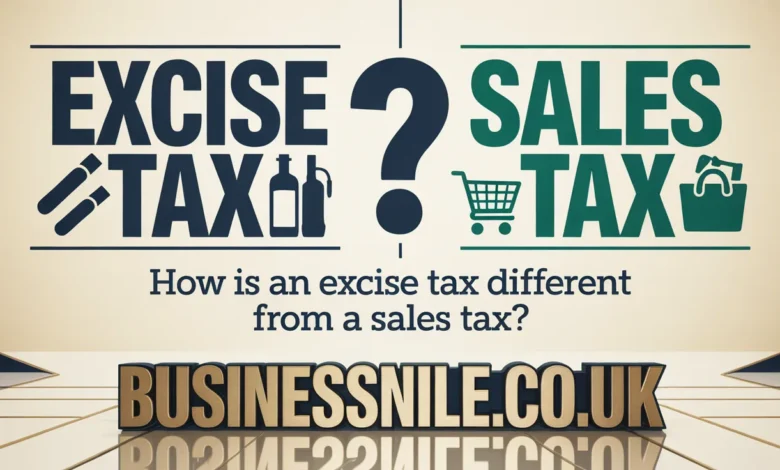
Understanding the difference between an excise tax and a sales tax is essential for consumers, business owners, and anyone interested in how taxes affect everyday purchases. Although both are indirect taxes that can increase the price of goods, they serve different purposes and are applied in different ways. Many people mistakenly believe they are the same, leading to confusion about pricing and tax calculations. In this guide, you’ll learn How Is an Excise Tax Different from a Sales Tax? discover the most common misconceptions, and see real-world examples that make these tax concepts easy to understand.
What Is a Sales Tax?
A sales tax is a percentage added to the price of most goods and services at the point of sale. When you buy something at a store, the government charges you a percentage of the purchase price. The retailer collects that money from you and passes it on to the government.
Sales taxes are broad. They apply to a wide range of products and services across the board. In the United States, for example, most states charge a sales tax that ranges from around 2.9% to over 10%, depending on where you live.
Here is what makes sales tax straightforward:
- It is visible on your receipt
- It is calculated as a percentage of the total price
- It applies to the consumer directly
- It is collected by the seller at the time of purchase
- It varies by state, county, or city
For example, if you buy a $100 pair of shoes in a state with a 7% sales tax, you pay $107 at the register. Simple and transparent.
What Is an Excise Tax?
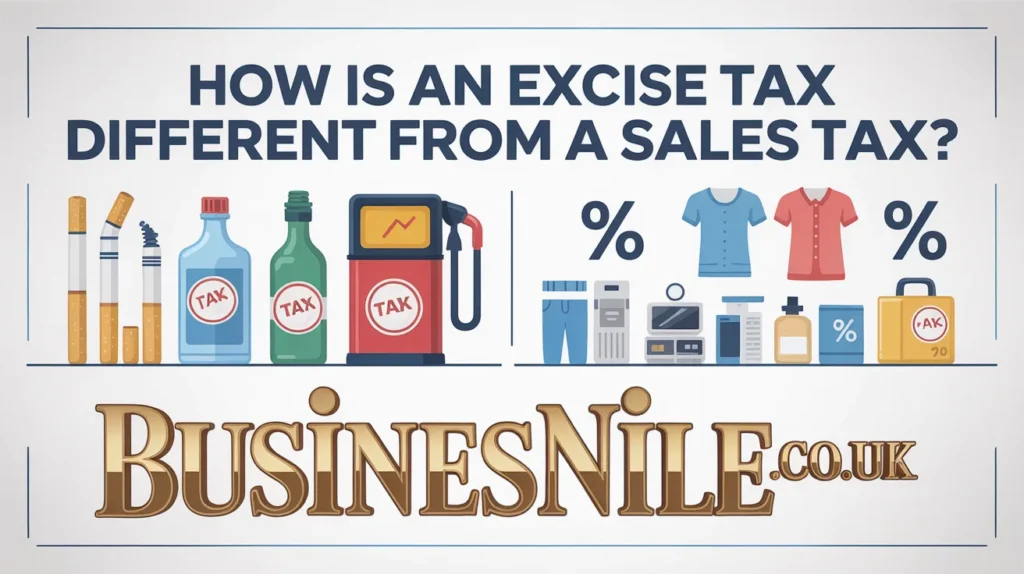
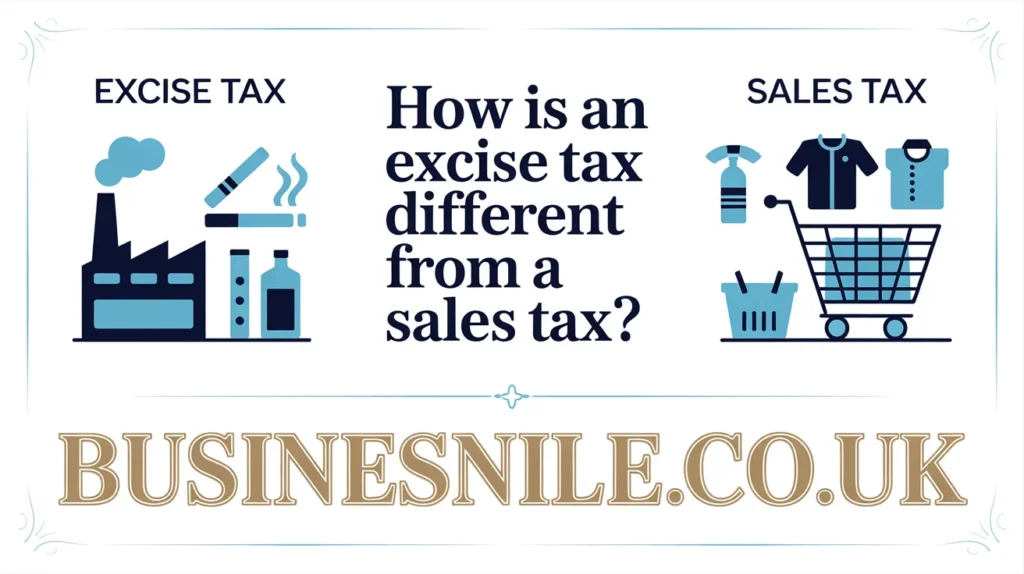
An excise tax is a tax placed on specific goods, services, or activities. Unlike sales taxes, excise taxes are usually built into the price of the product. You often pay them without even realizing it.
Excise taxes typically target items like:
- Gasoline and fuel
- Tobacco products
- Alcohol
- Airline tickets
- Firearms and ammunition
- Gambling winnings
- Certain luxury goods
Governments use excise taxes for two main reasons. First, they want to raise revenue. Second, they want to discourage the use of certain harmful products. This is why excise taxes on cigarettes and alcohol tend to be especially high.
The federal government collects excise taxes. State governments do too. Sometimes both collect excise taxes on the same product, which means you might be paying multiple layers of tax without knowing.
How Is an Excise Tax Different from a Sales Tax? The Core Breakdown
Now let us get into the heart of the question: how is an excise tax different from a sales tax?
The differences go deeper than most people expect. Here is a clear comparison:
1. Who Pays the Tax
With a sales tax, you, the consumer, pay it directly. The retailer just collects it on behalf of the government.
With an excise tax, the producer or manufacturer usually pays it first. However, they pass the cost on to you through the product price. So you still pay it, but indirectly.
2. What Products Are Taxed
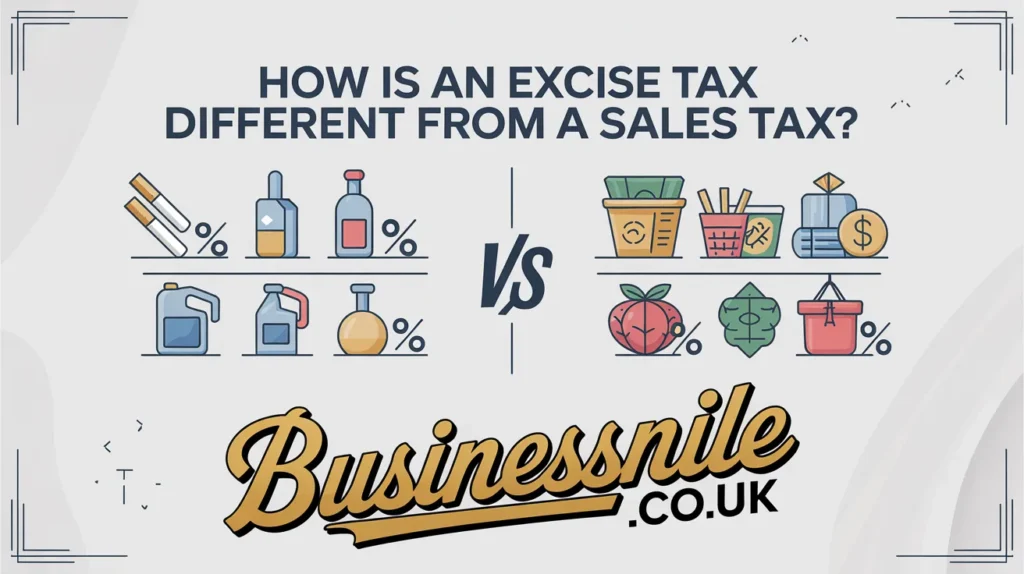
Sales taxes apply broadly to most goods and services. Excise taxes target only specific products or activities, usually ones the government wants to regulate or tax heavily for public policy reasons.
3. How the Tax Is Visible
Sales tax is transparent. You see it as a line item on your receipt. Excise tax is often invisible. It is already baked into the sticker price before you even pick the item up.
4. How the Tax Is Calculated
Sales taxes are calculated as a percentage of the purchase price. Excise taxes can be either a flat amount per unit (like cents per gallon of gasoline) or a percentage of the price. For example, the federal excise tax on gasoline is 18.4 cents per gallon, regardless of the total price.
5. Purpose and Policy Goal
Sales taxes are primarily about raising general revenue for governments. Excise taxes often serve a dual purpose: raising money and changing consumer behavior. Taxing cigarettes heavily, for example, is meant to discourage smoking while also bringing in revenue.
Real World Examples That Make It Crystal Clear
Understanding how is an excise tax different from a sales tax becomes much easier when you look at real examples.
Example 1: Buying Gasoline
When you pull into a gas station and pay $3.50 per gallon, you are not just paying for the fuel. Roughly 18.4 cents per gallon goes to the federal government as an excise tax. Many states add their own excise tax on top of that. You never see this itemized on a pump receipt. It is already in the price.
Example 2: Buying a New Laptop
When you buy a $1,000 laptop at an electronics store, you will see a sales tax of perhaps $80 added at checkout. That is visible, calculated on the spot, and paid by you directly. There is no federal excise tax on laptops.
Example 3: Buying Alcohol
When you buy a bottle of whiskey, you are hit with both. There is a federal excise tax built into the price the distillery charges. Then the retailer adds a sales tax when you buy it. You pay two layers of tax, but only one is visible.
Why Governments Use Both Taxes
Governments are practical. They use excise taxes and sales taxes for different reasons, and they like having both tools available.
Sales taxes generate large amounts of revenue reliably. Since they apply to so many purchases, even small percentages add up to billions of dollars for state governments.
Excise taxes give governments more control. If lawmakers want to reduce smoking rates, they raise the excise tax on cigarettes. If they want to fund highway maintenance, they raise the gas excise tax. It is targeted and purposeful.
I find it fascinating that excise taxes often go to specific funds. In many cases, federal gas excise taxes go directly into the Highway Trust Fund, which pays for road construction and repairs. That connection between the tax and how it is spent makes excise taxes feel more justified to many people. how is an excise tax different from a sales tax?
Excise Tax vs Sales Tax: Who Bears the Burden?
Economists talk about “tax incidence,” which just means who actually ends up paying the tax in the end.
For sales taxes, the incidence is clear. You, the buyer, pay it.
For excise taxes, it is a little more complicated. The manufacturer or producer pays the tax to the government first. But they simply raise their prices to cover it. So the cost flows down the supply chain to you.
However, how much of the excise tax you actually absorb depends on market competition. In a competitive market, companies absorb some of the tax by accepting lower profits. In markets with few competitors or inelastic demand (like cigarettes), they pass nearly all of it to consumers.
Are Excise Taxes Regressive?
Both excise taxes and sales taxes tend to be regressive. That means lower-income people pay a larger share of their income in these taxes compared to wealthier people.
If a low-income person and a high-income person both buy a gallon of gasoline, they pay the same excise tax. But for the lower-income person, that tax represents a much larger percentage of their total income.
This is a major criticism of both types of taxes. Policymakers often debate whether excise taxes, especially on necessities like fuel, are fair to working-class families.
Common Misconceptions About Excise and Sales Taxes
People mix these up all the time. Here are a few common myths:
Myth 1: Excise taxes are rare. They are actually everywhere. You encounter them every time you buy gas, book a flight, or purchase alcohol.
Myth 2: You always see both taxes on your receipt. Sales tax shows up on receipts. Excise tax usually does not. It is hidden in the base price.
Myth 3: Only federal governments charge excise taxes. Both federal and state governments charge excise taxes. Some local governments do too.
Myth 4: Excise taxes only apply to harmful products. While many excise taxes target alcohol, tobacco, and fuel, they also apply to things like indoor tanning services and certain medical devices.
How Is an Excise Tax Different from a Sales Tax in Terms of Compliance?
From a business perspective, the two taxes also differ in how they are handled.
With sales tax, a retailer collects it from customers and remits it to the state government. The burden of collection falls on the seller at the point of sale.
With excise tax, the obligation usually sits with the manufacturer, importer, or distributor. They pay the government before the product even reaches a retailer. This means excise tax compliance is handled much earlier in the supply chain.
Businesses that deal in excise taxable goods, like breweries, fuel distributors, or firearms dealers, must register with the appropriate government agencies and file regular excise tax returns. It is a more complex process than simply collecting a sales tax at the register.
Key Differences at a Glance
Here is a quick summary table to lock in the differences:
Sales Tax:
- Applied broadly to most goods and services
- Percentage of the total purchase price
- Visible on receipts
- Collected by the retailer from the consumer
- Revenue goes to state and local governments
Excise Tax:
- Applied to specific goods or activities
- Can be a flat fee per unit or a percentage
- Hidden in the product price
- Paid by producers and passed to consumers
- Revenue can go to specific funds (like highways)
How Is an Excise Tax Different from a Sales Tax When It Comes to Tax Evasion?
Tax evasion is a real concern for both types of taxes, but the risks differ.
Sales tax evasion often happens at the retail level. A business might fail to collect or remit sales tax on cash transactions.
Excise tax evasion tends to happen earlier in the supply chain. Black markets for cigarettes and alcohol exist in large part to avoid excise taxes. Bootleg tobacco and counterfeit liquor often carry no excise tax, which makes them cheaper and attractive to some buyers.
Governments invest heavily in enforcing excise tax compliance precisely because the dollar amounts involved can be enormous.
Conclusion
Understanding how is an excise tax different from a sales tax is not just a matter of academic curiosity. It affects your everyday spending, the prices you see on shelves, and the policies your government uses to shape behavior.
Here is the simple takeaway: sales taxes are broad, visible, and applied at the point of purchase. Excise taxes are targeted, often hidden in prices, and serve both revenue and policy goals.
The next time you fill up your gas tank or crack open a beer, you will know exactly what kinds of taxes you are quietly paying. That awareness alone can help you become a more informed consumer and voter.
Did you find this breakdown helpful? Share it with someone who has always wondered why cigarettes and gas cost so much. And if you have questions about other types of taxes, drop them in the comments. We would love to help you make sense of the tax world.
Frequently Asked Questions
1. How is an excise tax different from a sales tax in simple terms? A sales tax is a broad tax added to most purchases at checkout. An excise tax is a specific tax on certain goods like gas or cigarettes, usually built into the price before you buy it.
2. Do you pay both excise tax and sales tax on the same product? Yes, sometimes. Alcohol, for example, can carry both a federal excise tax built into the price and a state sales tax added at the register.
3. Who collects excise taxes? Excise taxes are usually paid by manufacturers, producers, or importers. They collect them on behalf of the federal or state government before the product reaches stores.
4. Are excise taxes included in the price you see? Yes, in most cases. Excise taxes are embedded in the retail price, so you pay them without seeing them itemized on a receipt.
5. Why are excise taxes used on cigarettes and alcohol? Governments use high excise taxes on these products to discourage their use (especially among young people) and to raise revenue for public health and other programs.
6. Is a gas tax an excise tax? Yes. The federal gas tax of 18.4 cents per gallon is a classic example of an excise tax. Most states add their own gas excise taxes on top of that.
7. Which tax is higher, excise or sales tax? It depends on the product. Excise taxes on cigarettes and alcohol can be very high. Sales taxes are generally more moderate but apply to a much wider range of goods.
8. Are excise taxes fair? Like sales taxes, excise taxes tend to be regressive, meaning they take a larger share of income from lower-income households. This is a common criticism of both types of taxes.
9. How is an excise tax different from a sales tax when it comes to businesses? Businesses collecting sales tax do so at the point of sale. Businesses subject to excise taxes pay them much earlier in the supply chain and must register with specific agencies.
10. Can excise taxes change over time? Yes. Governments regularly adjust excise tax rates through legislation. Tax rates on cigarettes, alcohol, and gasoline have all changed significantly over the decades.
Also Read In BusinessNile.co.uk
Email: johanharwen314@gmail.com
Author Name: Hamid Ali
About the Author: Hamid Ali is a personal finance writer and tax literacy advocate with over a decade of experience breaking down complex financial topics for everyday readers. He has written for several finance-focused publications and believes that understanding how taxes work is one of the most empowering things any person can do for their financial future. When he is not writing, Hamid enjoys hiking, reading economic history, and explaining tax concepts to anyone willing to listen.